AI Visibility: See Which AI Crawlers and Assistants Visit Your Site
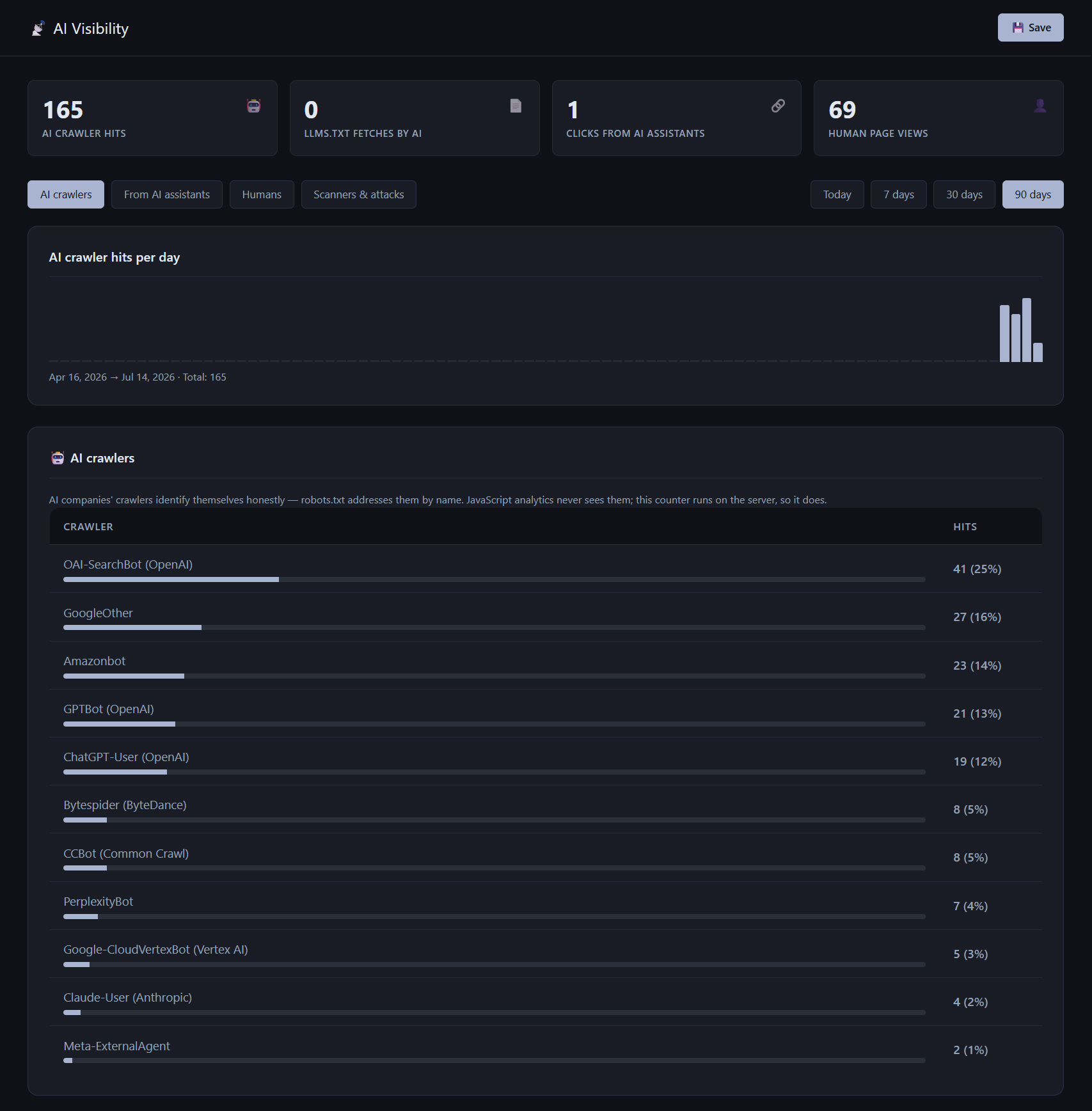
AI Visibility is a free AliothPress plugin that shows how AI reads your website: which AI crawlers visit and what they read, whether your /llms.txt file gets fetched, and which visitors arrive from AI assistants such as ChatGPT, Perplexity, Microsoft Copilot, and Google Gemini. It also counts human page views with a lightweight cookieless beacon. Everything runs on your own server, every byte of data stays in your own database, and the report lives right in your admin panel.
Why measuring AI readership matters
Search is changing. People increasingly ask an AI assistant and read its answer instead of clicking through ten blue links. For a website owner this means a new kind of audience: crawlers that read your content so an AI can cite it later, and assistants that send real visitors your way when they recommend your pages. Classic analytics tools were built for the old world. They run on JavaScript, and crawlers skip JavaScript entirely, so this whole layer of traffic stays invisible to them. AI Visibility watches the layer where it actually happens: the server.
What the plugin shows you
The report is organized into four tabs on a single admin page.
AI crawlers. The plugin recognizes 33 AI crawlers by name, including GPTBot, ChatGPT-User and OAI-SearchBot (OpenAI), ClaudeBot and Claude-SearchBot (Anthropic), PerplexityBot, Google-Extended, Gemini Deep Research, Bytespider (ByteDance), CCBot (Common Crawl), Meta-ExternalAgent, Amazonbot, DuckAssistBot, Grok (xAI), DeepSeek, Mistral, Cohere, and more. Classic search engines (Googlebot, Bingbot, YandexBot and six others) are counted in their own group, so AI activity stays clearly separated from regular SEO crawling.
What machines read. Requests for /llms.txt, robots.txt, and your XML sitemap are tracked one by one. A fetch of /llms.txt is the clearest possible signal that an AI system is studying your site the way the llms.txt standard intends. You also see which content pages each crawler group requests.
Visitors from AI assistants. When ChatGPT, Perplexity, Copilot, Gemini, Claude, DeepSeek, Meta AI, Grok, or one of 17 recognized assistant platforms cites your page and a person clicks through, that visit is attributed to its source. This is the number that answers the modern question: is AI actually sending me people?
Human page views. A tiny inline beacon of roughly 400 bytes counts real visitors after the page has loaded. It is cookieless, it fires almost exclusively in real browsers because crawlers skip JavaScript, and it is rate-limited per IP to keep the numbers honest.
As a bonus, a Scanners tab counts vulnerability probes: requests for paths like wp-login.php that only ever come from attack tools, plus known scanner user agents. On a Python CMS every such request is a probe by definition, so the tab doubles as a quiet security radar.
How it works under the hood
Bot detection runs server-side in a single lightweight hook that inspects each request after your page has already been rendered and sent. It catches every request that reaches the application, including probes that end in a 404, which is exactly why scanners are visible at all. The human counter is the only part that uses JavaScript, and that separation is deliberate: machines are counted where machines live (the server), people are counted where people live (the browser).
Data is stored as aggregated daily counters in a single table inside your existing database. You choose how long to keep it: 90, 180, 365, or 730 days, and old rows are cleaned up automatically.
Privacy by design
AI Visibility follows the same privacy-first rules as the AliothPress core. It works cookieless, it stores aggregated daily counts rather than individual profiles, and personal data stays out of storage entirely. Every request the plugin handles is first-party: your server, your database, your admin panel. Your site keeps qualifying for banner-free operation exactly as it did before the plugin was installed.
Settings
Tracking and the human beacon can each be switched on and off separately. Retention is a dropdown. And if a new crawler appears tomorrow, you can add your own bot signatures in a plain text field, one user-agent substring per line, and the plugin starts counting it immediately.
Installation
AI Visibility is free, installs from the admin panel in one click from the plugin catalog (or as a ZIP upload), and requires AliothPress 2.4 or newer. The admin interface is available in all 31 languages. Your statistics survive plugin updates and reinstalls, because the data lives in your database rather than in the plugin folder.
AI Visibility measures the results of the work your site is already doing. AliothPress generates /llms.txt, FAQPage and Speakable schema, and answer-first content out of the box, as described in Built-in SEO and AEO, and it can expose your content to AI agents as callable tools via WebMCP. With AI Visibility you see the third piece: proof that crawlers arrive, read what you published, and send visitors back.