Multilingual CMS: Build Multilingual Website with AliothPress
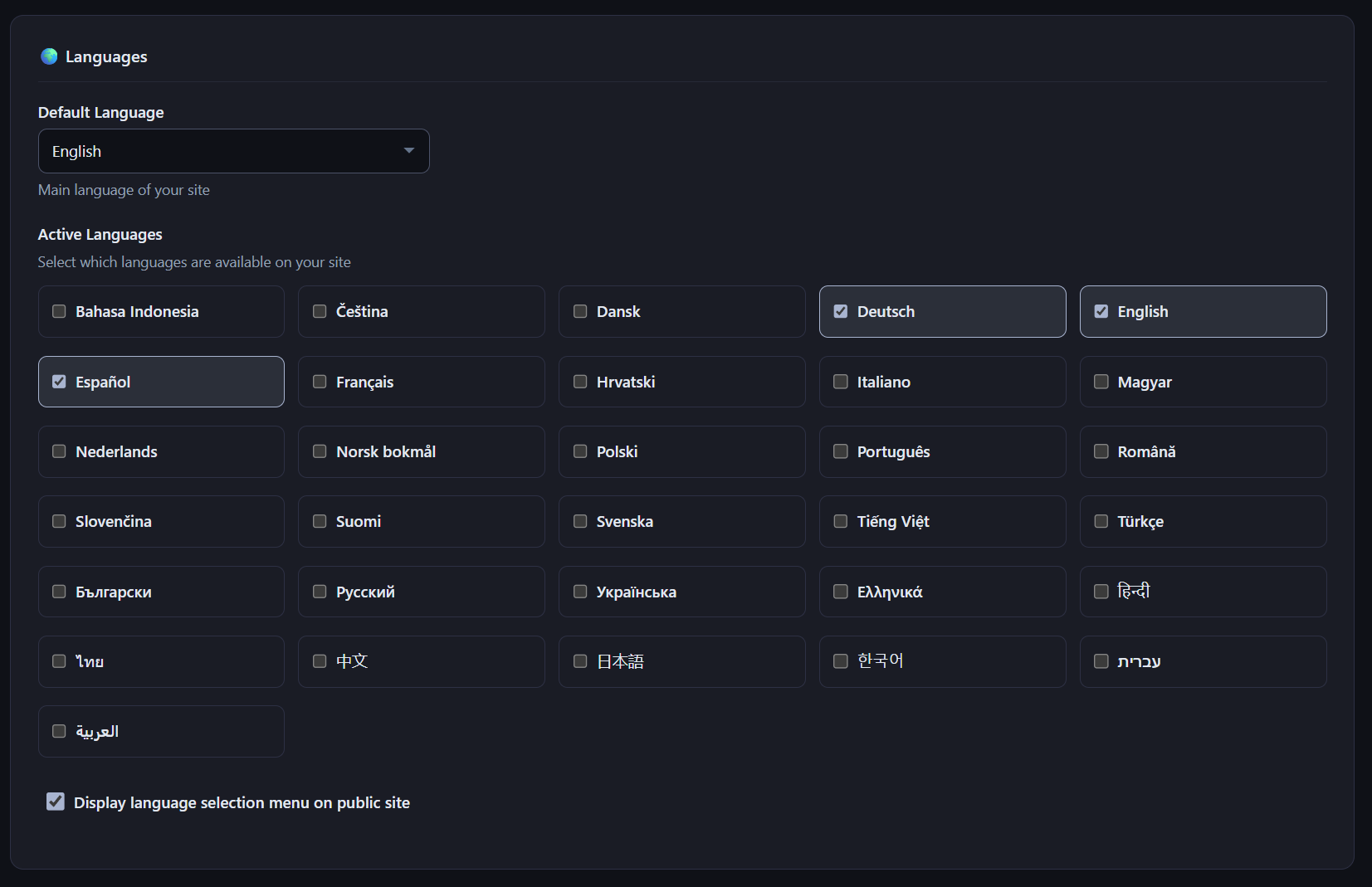
AliothPress builds multilingual websites in 31 languages as a core capability. Content in different languages is linked through translation groups, so the language switcher, hreflang tags, sitemap, and feeds stay synchronized automatically. Menus, forms, newsletters, and legal pages are language-aware, right-to-left scripts render correctly for Arabic and Hebrew, and every admin user works in a panel language of their own choice. The AI Assistant translates posts and pages while preserving structure and linking the result into the correct translation group.
31 languages across scripts
The supported set covers Latin, Cyrillic, Greek, Hebrew, Arabic, Devanagari, Thai, Chinese, Japanese, and Korean scripts: English, German, French, Spanish, Italian, Portuguese, Dutch, Polish, Czech, Slovak, Croatian, Romanian, Hungarian, Bulgarian, Ukrainian, Russian, Greek, Danish, Swedish, Norwegian, Finnish, Turkish, Indonesian, Vietnamese, Hindi, Thai, Chinese, Japanese, Korean, Hebrew, and Arabic. The default language is chosen during installation, and any subset of the 31 can be activated later.
Translation groups link content across languages
Each post, page, form, and newsletter carries a translation group ID. Linking a German page to its English original takes one selection, and one language per group is enforced at the database level, so duplicates cannot occur. From that link, AliothPress derives everything else without further work:
- The language switcher on the public site leads visitors to the same content in their language, including anchors within a page.
- Hreflang alternates appear in the HTML head, the XML sitemap, and the RSS and Atom feeds. Details are in the Built-in SEO and AEO article.
- Deleting one translation never breaks the others; the group simply shrinks.
Language-aware menus, legal pages, forms, and newsletters
Menus are built once as a single tree and resolved into each visitor's language automatically: items anchored to translation groups appear with that language's own slug and title, custom links carry per-language URLs and labels, and content without a published translation is hidden in that language only, never site-wide. The full behavior, including three-level nesting, is covered in the Menus article.
Legal pages are created in the site's default language at installation and can be translated like any other page, keeping imprint and privacy texts correct for each audience.
Forms and newsletters belong to translation groups too. A subscriber who signed up through the German form receives the German newsletter. The Forms and Newsletter articles cover this in depth.
Right-to-left rendering switches on automatically: pages in Arabic and Hebrew are served with the correct text direction, and all 15 themes handle it.
AI translation built in
The AI Assistant translates a post or page into any supported language, keeps headings, formatting, and structure intact, carries the SEO fields along, and attaches the result to the source's translation group. Manual translation works the same way for teams that prefer it; the assistant is an accelerator, and every translated text remains editable.
Admin panel in each user's language
Admin panel language is a personal setting per user, independent of the site's public languages. A team spread across countries works in one admin panel, each member in one of the 31 languages. The interface itself ships fully translated.
Key multilingual features in AliothPress
31 languages across ten scripts, translation groups that keep the switcher, hreflang, sitemap, and feeds synchronized, a single menu tree resolved into each language with its own slugs and labels, language-aware forms and newsletters, automatic RTL for Arabic and Hebrew, AI translation into any supported language, and a per-user admin panel language. All of it ships in the core.